You call a repair company about your dishwasher, and the first question is: “What’s the model and serial number?” Now you’re crouched next to the machine with a phone flashlight, hunting for a sticker you’ve never looked at.
It doesn’t have to be that stressful. Those two numbers tell you a lot: how old your appliance is, which parts fit it, whether it might be under warranty, and whether it’s part of a safety recall. This guide shows you where to find them, how an appliance serial number lookup works, and what to do with the result.
The short version:
-
The model number identifies the type of appliance. The serial number identifies your specific unit.
-
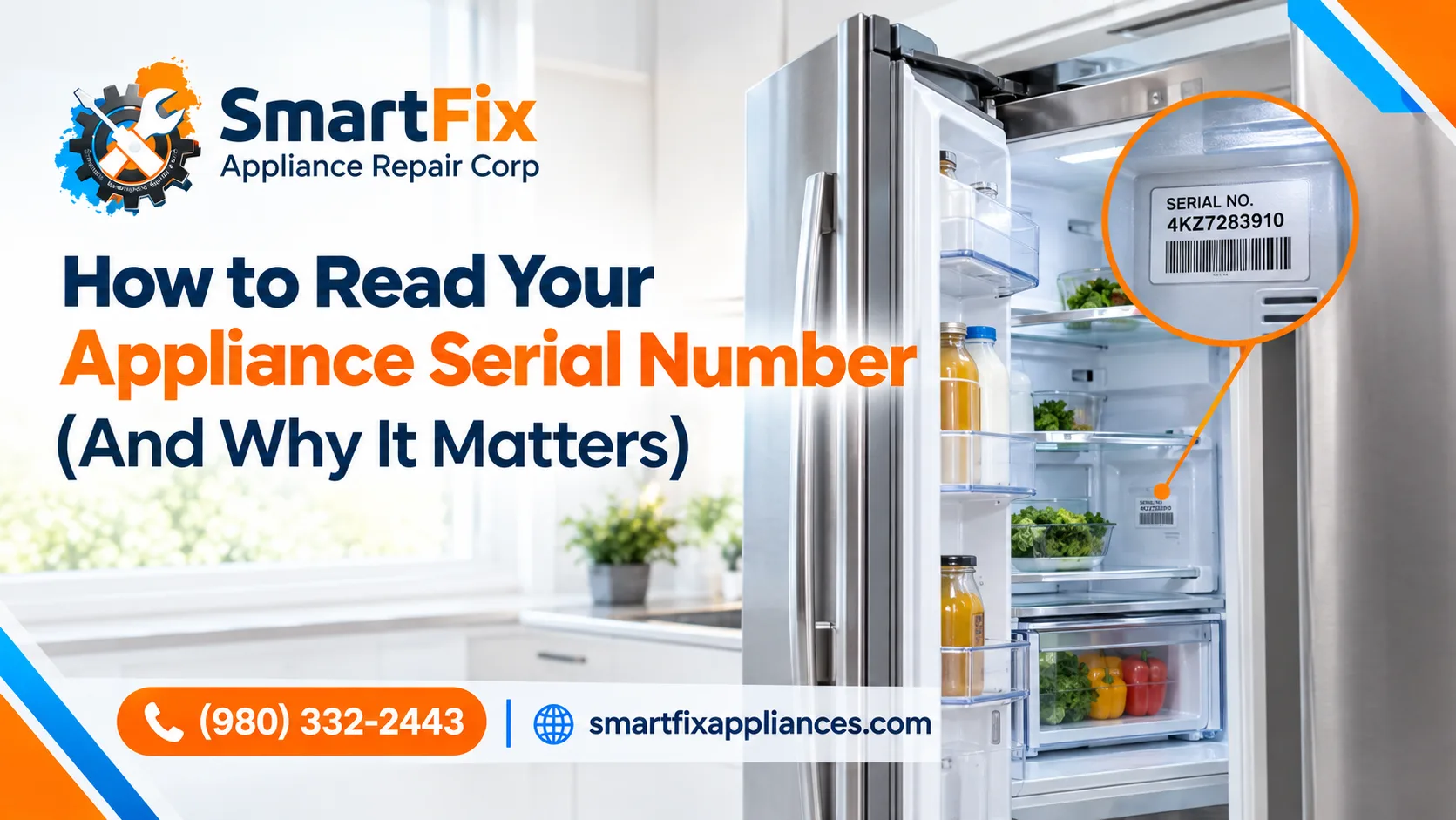
Both are printed on a rating label, usually inside the door, on the frame, or on the back.
-
On many brands, the first characters of the serial number encode the manufacture date.
-
You’ll need both numbers for parts, warranty claims and recall checks.
Model Number vs. Serial Number: What’s the Difference?
They sit side by side on the same label, so people mix them up. They do different jobs.
|
Model number |
Serial number |
|
|
Identifies |
The type of appliance |
Your individual unit |
|
Shared with other units? |
Yes |
No |
|
Use it for |
Parts, manuals, specs |
Manufacture date, warranty, recalls |
Think of a car: the model is “2020 Honda Civic,” and the serial number is the VIN that belongs to your car alone.
When you do an appliance model number lookup to order a part, copy the full string, including letters and dashes. One wrong character can mean the wrong part and a return trip to the store.
Where to Find the Serial Number on Every Major Appliance
Brands vary, but locations follow a pattern by appliance type. According to Whirlpool’s model and serial number finder, refrigerators carry the label inside, on the wall, while washers, dryers, dishwashers and microwaves usually have it inside on the rim, and cooktops have it on the underside of the unit.
Here’s what that means in practice:
|
Appliance |
Where to look |
|
Refrigerator |
Inside the fresh food compartment, usually on a side wall. Depending on the model, the label may also be on the ceiling of the compartment or another location specified by the manufacturer. |
|
Washer / dryer |
Door frame or rim; under the lid on top-loaders |
|
Dishwasher |
Inside, on the rim. On built-in models, check the left side of the tub frame. |
|
Range / oven |
Inside the oven drawer or on the oven rim |
|
Cooktop |
Underneath the unit |
|
Microwave |
Whirlpool’s help page lists a different spot for nearly every appliance type, so if yours isn’t in the table, check their full location guide.
Pro tip from our technicians: Photograph the label and save it in a phone note called “Appliance info.” Next time something breaks, you won’t have to pull the fridge away from the wall. Also, many refrigerators ship with a registration card that lists the full model and serial number, so it’s worth digging out your paperwork.
How to Use an Appliance Serial Number Decoder
The serial number isn’t random. On many brands, it hides the month and year your appliance was built. An appliance serial number decoder simply translates that code into a date.
The process is the same for most brands:
-
Write down the full serial number (not the model number).
-
Identify the brand, because each manufacturer uses its own system.
-
Use the brand’s official date code chart or lookup tool.
-
Cross-check the result against your purchase date or manual.
Example: decoding a GE serial number
GE’s own support page explains the system. GE serial numbers begin with two letters, followed by six numbers and a letter at the end, and the first two letters tell you the month and year of manufacture. The first letter is the month, and the second is the year.
There’s a catch. The year letter rotates roughly every 12 years, so one serial number can point to more than one year. GE’s example: “AD” could mean January 2002 or January 2014. That’s why step 4 matters. GE suggests checking the print date in the owner’s manual to pin down the right year.
A word of caution: Formats differ by brand and have changed over the decades. A code that works for GE won’t work for Whirlpool, Samsung or Bosch. If a decoder’s answer doesn’t match what you know about the appliance, go back to the manufacturer’s own chart instead of trusting a generic third-party tool.
Why Your Serial Number Matters
It helps you decide: repair or replace?
Age is the biggest factor in this decision. According to Consumer Reports’ home and appliance writer, as reported by NerdWallet, most people now expect an appliance to last about 10 years, and Consumer Reports has moved beyond its old “replace if repair costs over 50%” rule toward a tool that weighs purchase price, age and repair cost. You can read the full discussion in NerdWallet’s guide to repairing or replacing appliances. Without the manufacture date from your serial number, you’re guessing at one of those inputs.
It clarifies your warranty
Coverage often runs from the purchase or manufacture date. A quick decode can tell you whether it’s worth contacting the manufacturer before you pay for service.
It gets you the right part
Parts are matched by model, and sometimes by production run. The more precise your numbers, the lower the chance of ordering something that doesn’t fit.
It tells you whether your appliance is recalled
Recall notices specify affected models and date ranges, so you generally need both numbers to know if your unit is included. Search by brand and product type on the U.S. Consumer Product Safety Commission’s recalls page. If you’ve had a problem with a product, you can also report it at SaferProducts.gov, where CPSC investigators review each report to decide what action to take.
It makes service faster
When a technician knows the exact model and serial before arriving, they can often bring the right part. That usually means one visit instead of two.
Appliance Serial Number Lookup: Where to Do It (and Where It Falls Short)
For a reliable appliance serial number lookup, start with these:
-
The manufacturer’s website. Brands like GE publish official date code charts and age-finder pages.
-
Your owner’s manual. It often carries a print date that helps confirm the year.
-
The CPSC recall database. Use it to check models and date ranges.
-
Product registration. Registering ties your serial number to your purchase, which makes warranty claims simpler.
These tools have limits, though. Older units may use formats that modern tools don’t recognize. Some brands share parts or sell under several names. And if the label is damaged or gone, there’s nothing to look up.
Can’t Find Your Appliance’s Serial Number? Here’s What to Do
Labels can fade, get painted over, or be hidden behind a built-in appliance. If you can’t find the serial number, try these steps:
-
Check the manual and registration card. Some list the numbers.
-
Look through purchase paperwork. Receipts and delivery slips sometimes include the model and serial.
-
Check for a number stamped into the frame. Some appliances have one even when the sticker is gone.
-
Call a local technician. An experienced tech knows where each brand hides its label and can often identify the model from the unit itself.
If you’re in Charlotte, NC, our technicians can help identify your appliance and determine whether a repair makes sense.
4 Common Mistakes to Avoid
-
Reading the model number as the serial number. Only the serial number encodes the manufacture date.
-
Skipping the cross-check. Because year codes repeat, always compare with a manual date or purchase record.
-
Using a generic decoder for every brand. Formats differ. Use the manufacturer’s chart.
-
Copying the number from memory. Photograph the label instead.
Before You Call a Technician: Quick Checklist
-
Model number
-
Serial number
-
Purchase date (if known)
-
A short description of the problem (noises, error codes, when it happens)
-
A photo of the label
Know Your Appliance Before It Breaks
A serial number is a small detail with a big payoff: it tells you how old your appliance is, helps you get the right parts, and lets you check for recalls. Take two minutes today, photograph the label on each major appliance, and save the photos in one place.
If you get stuck, or your appliance has already broken down, SmartFix Appliance Repair is ready to help. Call us or schedule service online.
FAQ
Where is the serial number on my refrigerator?
Usually inside the fresh food compartment, often on a side wall. The exact location varies by model, so check your owner’s manual or the manufacturer’s location guide.
How do I find my appliance’s age from the serial number?
Use the manufacturer’s date code chart or age-finder page, then confirm the year with your owner’s manual or purchase date.
Is the model number the same as the serial number?
No. The model number identifies the type of appliance. The serial number identifies your individual unit, and it’s the one that contains the date code.
Can I check my warranty with a serial number?
Often, yes, especially if you’ve registered the product. When in doubt, contact the manufacturer directly with both numbers.
What if the serial number sticker is missing?
Check the manual, registration card and purchase records. A technician can also help identify the unit from its features and components.