
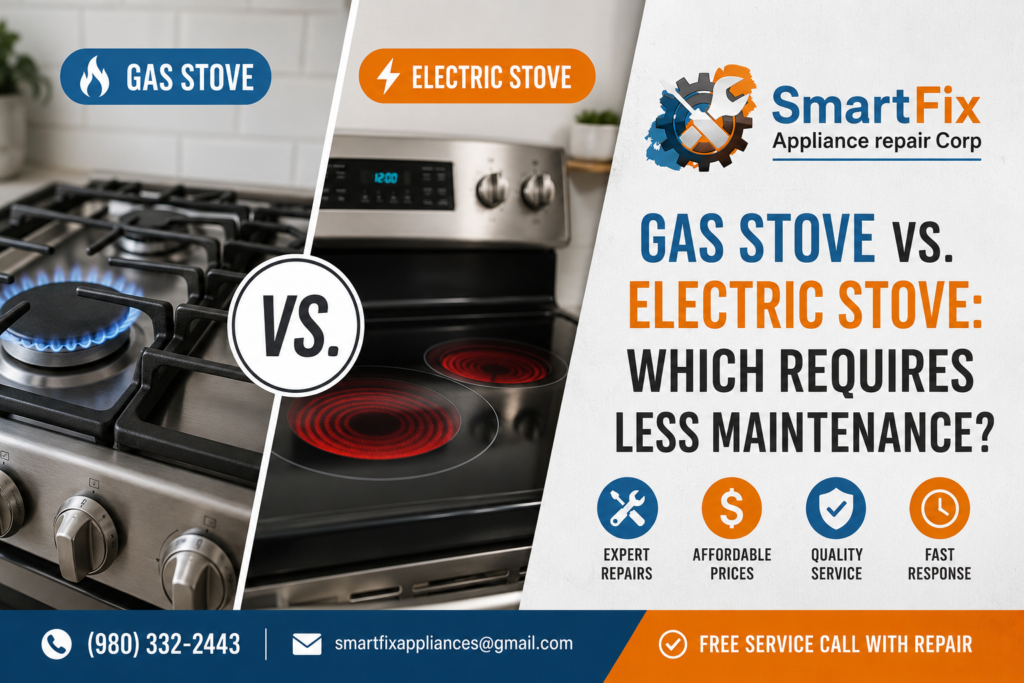
If your stove has started acting up — a burner that won’t light, a cooktop that heats unevenly, or a control panel that just stopped responding — it’s natural to wonder whether the fuel type is part of the problem. It’s one of the most common questions we hear from homeowners deciding between a gas and an electric range: which one is going to mean fewer headaches (and smaller repair bills) down the road?
The honest answer is that it depends on what kind of maintenance you’re trying to avoid. Gas and electric stoves break down in different ways, need different kinds of routine care, and come with very different repair price tags when something does go wrong. Here’s how they actually compare.
How Gas Stoves Work — and What They Need
A gas stove relies on burners, an ignition system (either a spark igniter or a glow-bar igniter), a gas valve, and the line that feeds it. It’s a mostly mechanical system, which is both its biggest strength and its most common failure point.
The most frequent complaint we see is a burner that clicks but won’t light — usually a sign the igniter has weakened and can no longer get hot enough to open the gas valve. Clogged burner ports are another regular issue, especially in busy kitchens, since food debris and grease buildup can block the small holes that release gas evenly. A flame that burns yellow or orange instead of blue is worth a call to a technician, as it can point to a burner or air-mixture problem.
Routine care is fairly simple and mostly DIY-friendly:
- Remove and wash burner caps and grates in warm, soapy water regularly
- Clear burner ports gently with a soft brush or a pin made for the purpose
- Wipe up spills right away, before they bake onto the burner assembly
- Never ignore the smell of gas — shut off the supply, leave the house, and call your gas company before calling anyone else
How Electric Stoves Work — and What They Need
Electric ranges come in two main styles: older coil-element models and the smooth glass-ceramic tops that dominate today’s market. Both rely on electric heating elements and, in most modern units, an electronic control board that manages temperature and timing.
The most common electric stove repair is a burned-out heating element — visible as a crack, blister, or dark burn spot after years of use. Glass cooktops bring their own vulnerability: a dropped pot or a dragged pan can scratch or crack the surface, and once it’s cracked, it typically can’t be repaired, only replaced. Control board failures show up as unresponsive buttons, flashing error codes, or a stove that shuts off randomly, and these are more expensive to diagnose and fix than a simple mechanical part.
Routine care looks a little different:
- Wipe glass tops after each use with a cooktop-safe cleaner — never an abrasive pad, which causes the very scratches that lead to cracks
- Lift coil elements occasionally to clean underneath and confirm they’re seated firmly in their sockets
- Use flat-bottomed cookware on glass tops to avoid chipping the edges
- Keep the control panel and vents free of dust and moisture
Head-to-Head: Maintenance Comparison
| Factor | Gas Stove | Electric Stove |
| Everyday cleaning | More upkeep around burner caps and grates | Faster wipe-down, especially glass tops |
| DIY-friendly maintenance | Yes — burner and port cleaning | Yes — surface cleaning; elements/boards need a pro |
| Most common repair | Igniter replacement | Heating element or glass top replacement |
| Typical single-repair cost | Roughly $100–$400 | Roughly $100–$500+ |
| Priciest possible repair | Gas valve or regulator | Control board or glass cooktop |
| Expected lifespan with good care | 15–20 years | 13–15 years |
| Main safety consideration | Gas leaks — professional required for valve/line work | Electrical shorts — professional required for wiring/board work |
What Does It Actually Cost to Maintain Each Type?
Nationally, a typical single-part stove repair lands somewhere in the $150–$250 range, though the exact number depends heavily on what broke. Gas stove repairs tend to sit on the more affordable end of the spectrum — usually somewhere between $100 and $400 — because igniters, burner ports, and valves are simple, well-understood mechanical parts. Electric stove repairs can run higher, often $100 to $500 or more, largely because heating elements, glass cooktops, and control boards cost more in parts and take more diagnostic time.
That doesn’t automatically make one type “cheaper” overall — it mainly means gas stoves tend to have more frequent, smaller fixes, while electric stoves tend to have less frequent but sometimes pricier ones. A stove that’s maintained consistently, regardless of fuel type, will need far fewer of these repairs in the first place — which is exactly why we build a free diagnostic into every SmartFix repair visit, so you know the real cost before any work begins.
Tips to Extend the Life of Either Stove
- Schedule a professional inspection once a year, even if nothing seems wrong
- Clean spills the same day — baked-on residue is what causes most burner and element problems
- Avoid running the oven’s self-clean cycle too often; the high heat puts extra stress on igniters and heating elements
- Keep exhaust vents and door gaskets clear so the unit isn’t working harder than it needs to
- Address small issues (a slow igniter, a burner that’s slightly uneven) before they turn into a full breakdown
So, Which Requires Less Maintenance?
If you’re measuring maintenance in terms of routine, hands-on chores, electric stoves — especially glass-top models — generally win. Wiping down a smooth surface takes less time than cleaning burner caps and grates.
If you’re measuring maintenance in terms of what happens when something actually breaks, gas stoves tend to have the edge. Their mechanical parts are simpler, repairs are usually less expensive, and with consistent burner care, gas ranges often last a few years longer than their electric counterparts.
There’s also a local factor worth mentioning: natural gas service is widely available across the Charlotte area, which is part of why gas ranges remain such a popular choice here. But plenty of homeowners prefer the easy cleanup and steady heat of an electric range — and with a smooth top and regular care, they hold up very well too.
The Real Deciding Factor
Whichever type of stove you own, the single biggest thing that determines how much maintenance it needs isn’t gas versus electric — it’s consistency. A stove that gets cleaned regularly and looked at the moment something seems off will almost always outlast and out-perform one that’s ignored until it stops working entirely.
If your gas or electric stove is acting up, or it’s simply been a while since it had a proper check-up, SmartFix Appliance Repair is here to help. We repair all major stove, range, and oven brands throughout Charlotte and the surrounding areas, with day-of service available and a free service call when you move forward with the repair.
Call (980) 332-2443 or reach out at smartfixappliances@gmail.com to schedule your stove repair today.